
A 40 ton gantry crane used outdoors must be designed around more than its 40-ton rated lifting capacity. Wind exposure, ground conditions, load dimensions, lifting height, travel routes, and operating frequency all affect how safely and efficiently the crane can handle heavy materials.
For outdoor applications such as steel yards, precast concrete plants, shipyards, bridge construction sites, machinery assembly areas, and fabrication yards, three factors deserve particular attention: wind, ground conditions, and the characteristics of the lifted load. A crane that is correctly rated for 40 tons can still be unsuitable for a site if its supporting ground, wind protection, or load-handling configuration has not been properly evaluated.
This guide explains the main technical considerations when selecting and operating a 40 ton gantry crane for outdoor material handling.
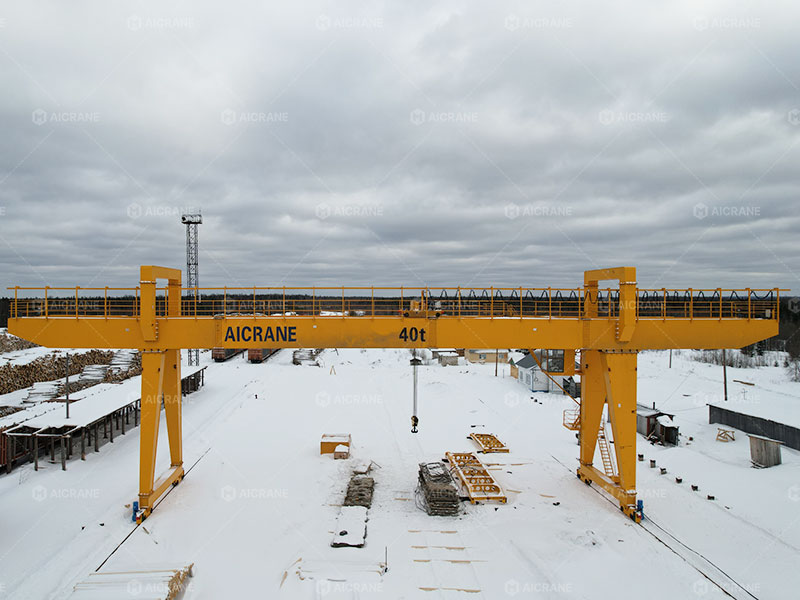
What Is a 40 Ton Gantry Crane?
A 40 ton gantry crane is a heavy-duty overhead lifting system with a rated lifting capacity of up to 40 metric tons (40,000 kg) under its specified operating conditions. Unlike an overhead crane, a gantry crane is supported by legs that transfer the crane loads to rails, ground-supported runways, or another engineered travel surface.
A typical 40 ton gantry crane may include:
- Main girder
- Supporting legs
- End carriages and traveling wheels
- Hoisting mechanism
- Trolley
- Electrical control system
- Limit switches and safety devices
- Crane travel and trolley travel mechanisms
For outdoor use, the crane configuration normally needs to account for environmental exposure. This can include rain, temperature variation, wind loads, dust, uneven ground conditions, and outdoor storage of the lifted materials.
The 40-ton rating describes the maximum rated load, but it does not mean that every 40-ton load can be lifted under every outdoor condition. The actual allowable operation depends on the crane’s design, duty classification, load characteristics, site conditions, and applicable safety requirements.
1. Wind Conditions Can Significantly Affect Outdoor Crane Operation
Wind is one of the most important differences between indoor and outdoor gantry crane applications.
A large outdoor load can behave like a sail. This becomes more significant when the load has a large surface area relative to its weight. Steel plates, structural sections, containers, precast panels, fabricated equipment, and large machinery can all experience substantial wind forces during lifting.
Why wind matters during lifting
Wind can affect a 40 ton gantry crane in several ways:
- The suspended load can swing.
- The crane structure can experience additional lateral forces.
- Traveling with a suspended load becomes more difficult.
- Large loads may rotate because of aerodynamic forces.
- Strong wind can increase the risk of load or crane instability.
The critical point is that wind does not simply act on the crane itself. It also acts on the projected area of the suspended load.
For example, a compact steel component weighing several tons may have relatively limited wind exposure. A large precast concrete wall panel with a much greater projected surface area can experience substantially different wind forces even when the weight is similar.
Therefore, outdoor crane selection should consider both load weight and load geometry.
Wind-related design considerations
The engineering specification should define the applicable wind conditions for the crane’s operating environment. Depending on the project and local requirements, this can include:
- Maximum allowable operating wind speed
- Maximum non-operating wind speed
- Wind load on the crane structure
- Wind load on suspended loads
- Parking and anchoring requirements
- Rail clamps or other anti-wind devices where applicable
A crane intended for outdoor use should not be operated beyond the manufacturer’s specified environmental limits simply because the lifted load is below 40 tons.
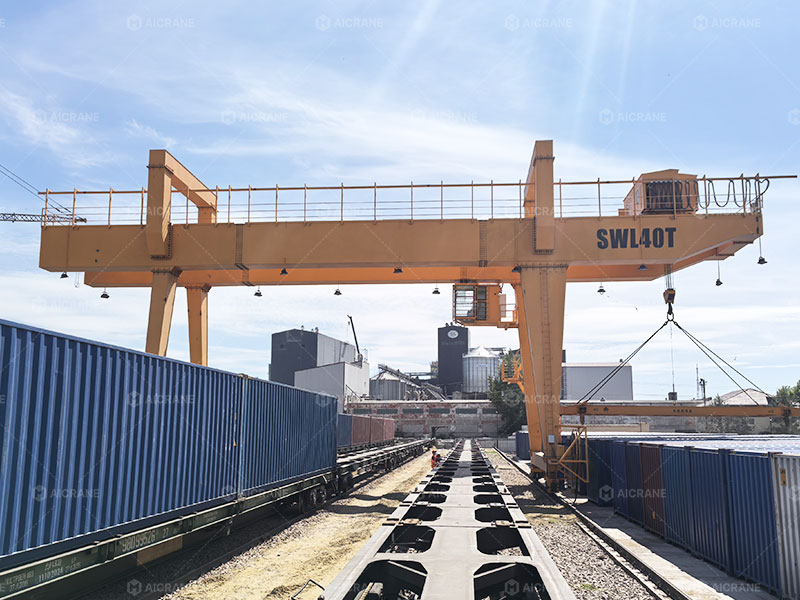
2. Ground Conditions Determine How the Crane Loads Are Supported
The second major consideration is the ground or runway system.
A 40 ton gantry crane transfers substantial vertical and horizontal forces through its wheels and supporting structure. The actual load applied to the ground is therefore not simply “40 tons divided by the number of wheels.”
The crane’s self-weight, lifted load, trolley position, wheel arrangement, dynamic effects, and site geometry all contribute to wheel loads.
Rail-mounted gantry cranes
For a rail mounted gantry crane 40 ton, rails are normally installed on an engineered foundation or runway system.
The supporting system needs to provide:
- Adequate bearing capacity
- Sufficient rail alignment
- Stable elevation
- Appropriate drainage
- Resistance to settlement
- Suitable lateral stability
Uneven settlement between rails can create alignment problems. Excessive rail misalignment may increase wheel flange forces, resistance to travel, and mechanical wear.
For long-term outdoor operation, drainage is also important. Standing water around foundations can contribute to soil deterioration, corrosion, and settlement problems.
Ground-supported gantry cranes
Some gantry cranes are designed to operate directly on prepared ground or a specific paved surface rather than a conventional elevated runway.
In this case, the site needs to be assessed for:
- Soil bearing capacity
- Surface flatness
- Ground compaction
- Wheel contact pressure
- Drainage
- Slope
- Pavement strength
A hard-looking surface is not automatically a suitable crane travel surface. Asphalt, concrete, compacted soil, and interlocking paving systems can have very different load-bearing characteristics.
The gantry crane supplier or project engineer may therefore require information about the ground structure before confirming a configuration.
3. The 40 Ton Rated Capacity Is Not the Only Load Parameter
When evaluating a 40 ton gantry crane, buyers often focus on the headline capacity. However, the crane’s performance depends on several other load-related parameters.
Important parameters include:
| Parameter | Why It Matters |
|---|---|
| Rated capacity | Defines the maximum permitted lifting load |
| Load dimensions | Determines wind exposure and handling clearance |
| Load center of gravity | Affects stability and sling forces |
| Lifting height | Influences load travel and wind exposure |
| Span | Affects crane structural requirements |
| Load frequency | Influences duty classification |
| Load distribution | Determines how forces are transferred during lifting |
| Lifting points | Affect rigging and load stability |
A 40 ton crane lifting a compact machine and a 40 ton crane lifting a long steel structure are dealing with different engineering conditions.
4. Load Center of Gravity Must Be Considered
The center of gravity becomes particularly important when lifting long or irregular loads.
If the lifting points are not correctly positioned relative to the load’s center of gravity, the load may tilt immediately after leaving the ground.
For example, consider a long fabricated steel structure with a center of gravity located away from its geometric center. If two lifting points are positioned symmetrically without considering the actual center of gravity, one end may rise faster than the other.
This can create:
- Load tilting
- Uneven sling loading
- Unexpected rotation
- Reduced clearance
- Increased risk during positioning
For this reason, a lifting plan should identify the approximate weight, dimensions, center of gravity, lifting points, and rigging arrangement before a heavy outdoor load is lifted.
5. Lifting Height Changes Wind Exposure
Lifting height is another factor that connects load handling with outdoor environmental conditions.
A load positioned close to the ground may have relatively limited exposure to wind compared with the same load suspended several meters above the ground.
As lifting height increases, the load may encounter different wind conditions and can have a larger potential swing path.
A 40 ton gantry crane should therefore be evaluated based on its required lifting height, rather than capacity alone.
For applications involving tall precast elements, wind-sensitive steel structures, or large fabricated equipment, the lifting height should be considered together with the load’s projected area.
6. Crane Span Affects Structural Performance
The crane span is the distance between the gantry legs or runway rails.
A wider span provides greater coverage of the working area, but it also affects the structural design of the crane. The main girder must accommodate the required span while maintaining appropriate strength and stiffness.
For a 40 ton gantry crane, span selection should be based on the actual material-handling area rather than simply maximizing coverage.
A practical evaluation should consider:
- Maximum load dimensions
- Required working width
- Storage positions
- Vehicle access
- Building or yard layout
- Required hook approach
- Trolley travel distance
If the crane is used in a steel yard, for example, the span needs to cover the material storage and handling zone while maintaining sufficient clearance from surrounding structures and vehicles.
7. Duty Classification Affects Long-Term Performance
Two cranes can both have a 40 ton rated capacity but have very different operating requirements.
A crane used to lift several heavy loads per day does not experience the same operating cycle as a crane that performs repeated lifting, trolley movement, and long-distance travel throughout multiple shifts.
Duty classification helps describe the expected workload of the crane.
When specifying a 40 ton gantry crane, buyers should provide information such as:
- Number of lifts per hour
- Average load weight
- Maximum load weight
- Operating hours per day
- Number of working days
- Frequency of trolley travel
- Frequency of crane travel
This information allows the crane structure, hoisting mechanism, motors, brakes, wheels, and electrical components to be selected for the actual operating pattern.
8. Outdoor Crane Travel Requires a Suitable Operating Route
The travel route is particularly important for ground-supported or rail-mounted outdoor gantry cranes.
The route should be checked for:
- Surface level
- Rail alignment where applicable
- Obstructions
- Drainage channels
- Vehicle crossings
- Maximum slope
- Storage materials
- Pedestrian access
- Clearance from buildings and equipment
A crane may have sufficient lifting capacity but still be unable to operate effectively if the travel path is obstructed or has excessive slope.
For a 40 ton gantry crane, travel performance should therefore be evaluated together with the site’s physical layout.
9. Safety Devices for Outdoor Operation
Outdoor 40 ton gantry cranes commonly require safety equipment appropriate to the specific crane configuration and local regulations.
Depending on the design, this may include:
- Upper and lower lifting limit switches
- Overload protection
- Emergency stop systems
- Travel limit switches
- Anti-collision devices
- Audible or visual warning devices
- Rail clamps
- Storm anchoring systems
- Wind-speed monitoring systems
These devices do not replace proper operating procedures. They provide additional protection when the crane encounters abnormal operating conditions.
For cranes operating in exposed yards, wind-speed monitoring can be particularly useful when the site experiences rapidly changing weather conditions.
10. How to Specify a 40 Ton Gantry Crane for an Outdoor Project
A useful technical specification should provide more information than “40 ton outdoor gantry crane.”
At minimum, the initial inquiry should include:
- Rated capacity: 40 tons
- Crane type: Single girder or double girder gantry
- Span: Required distance between supporting legs or rails
- Lifting height: Required hook height
- Working class: Based on lifting frequency and operating hours
- Load type: Steel, precast concrete, machinery, fabricated structures, etc.
- Maximum load dimensions: Length, width, and height
- Operating environment: Outdoor yard, construction site, shipyard, etc.
- Ground/runway condition: Rail-mounted, concrete, asphalt, or prepared ground
- Power supply: Available voltage and frequency
- Control method: Pendant, wireless remote, cabin, or combination
- Wind conditions: Local operating and non-operating wind requirements
Providing these details allows the crane configuration to be evaluated against the actual application rather than relying only on the nominal 40 ton capacity.
Conclusion
A 40 ton gantry crane for outdoor material handling should be selected according to the complete operating environment, not rated capacity alone. Wind conditions determine how the crane and suspended load can operate outdoors; ground conditions determine how crane forces are transferred to the supporting surface; and load characteristics determine the required lifting, rigging, stability, and handling configuration.
For a reliable outdoor installation, the key parameters to evaluate are 40 ton rated capacity, span, lifting height, duty class, load dimensions, center of gravity, ground or rail conditions, travel route, wind limits, and safety devices.
The most useful approach is to define the actual load and site conditions first, then select the crane structure, hoist, traveling mechanism, controls, and safety equipment around those requirements. This produces a crane configuration that is better matched to the real material-handling task than simply choosing a crane based on its 40 ton capacity.