
Malaysia’s small precast concrete factory sector operates in a competitive environment where product quality and consistency are the primary differentiators between suppliers who secure long-term contracts and those who compete on price alone in a market that increasingly does not reward inconsistency. From drainage components and culverts serving the country’s expanding infrastructure network, to precast wall panels and structural elements for the affordable housing programs advancing across Selangor, Johor, and Sabah — the demand for precast concrete products that meet specification first time, every time, is not a quality preference. It is a commercial survival requirement in a sector where non-conforming products mean rejection, rework, and reputational damage that small operations can rarely absorb without lasting consequences.
At the center of precast concrete quality consistency sits a single controllable variable that small factories frequently underinvest in managing: the precision of their concrete mix batching. Specifically, the weighing accuracy of the self loading cement mixer that produces the concrete feeding their casting operations. This is not a peripheral technical concern for laboratory discussion. It is the operational foundation on which everything downstream — product strength, dimensional stability, surface finish, and compliance with the Malaysian Standards that precast product certification requires — either stands reliably or crumbles unpredictably. The argument for precise weighing on self loading cement mixers in Malaysian small precast factories is not merely about better concrete. It is about the commercial viability of operations whose product quality depends on it.
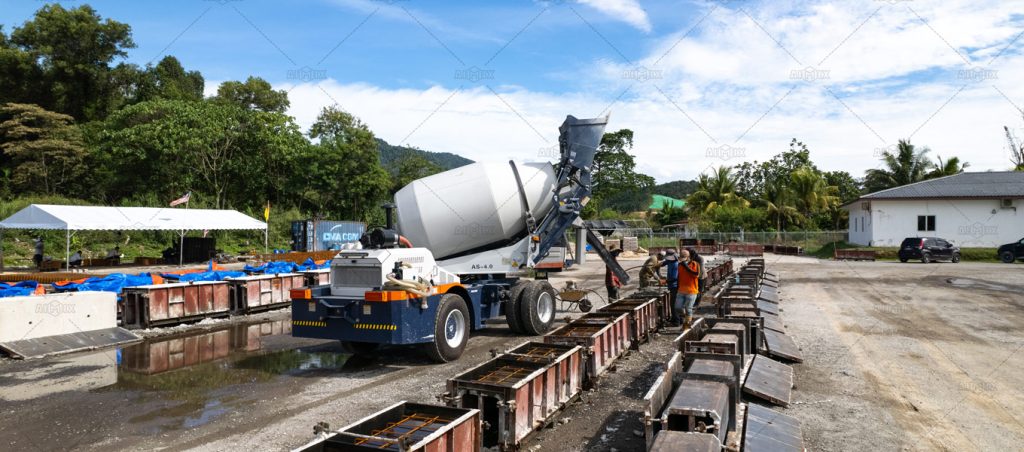
The Direct Connection Between Weighing Accuracy and Product Strength Compliance
Precast concrete products in Malaysia are specified to minimum compressive strength classes — MS 1195, SIRIM certification requirements, and the project-specific structural specifications that contractors and engineers impose as procurement conditions. Meeting these strength requirements is not optional. It is the baseline performance standard without which products cannot be certified, cannot be sold to quality-conscious buyers, and cannot be placed in structural applications where failure consequences extend beyond commercial inconvenience into professional liability and public safety.
Water-Cement Ratio Variability and Its Strength Consequences
The compressive strength of hardened concrete is governed more directly by water-cement ratio than by any other single mix design parameter. This relationship is well-established and unambiguous: as water-cement ratio increases, compressive strength decreases in a relationship that standard concrete mix design practice quantifies and specifies design mixes to control. A precast product designed for 40 MPa compressive strength at a water-cement ratio of 0.45 will not achieve that strength if the actual water addition during batching produces an effective water-cement ratio of 0.52 — even if the same cement content is used and the same curing procedure applied.
Self loading cement mixers without precise water metering systems introduce exactly this variability. When water addition relies on operator judgment — visual assessment of mix consistency, bucket count estimation, or flow time approximation — the batch-to-batch water content variation in a production day can be substantial. In Malaysian small precast factories, where a single self loading cement mixer Malaysia may produce twenty to forty drum loads per day feeding multiple casting lines, this variability compounds across the production volume into a product strength distribution whose lower tail may fall below the minimum strength specification with a frequency that random cube testing does not always catch before non-conforming products leave the factory.
Cement Content Accuracy and Its Commercial Implications
Cement is the most expensive ingredient in any concrete mix design, and its contribution to concrete cost per cubic meter is the primary variable that competitive precast pricing must manage. Self loading mixers with imprecise cement batching — relying on bag counts or volumetric estimation rather than gravimetric weighing — introduce cement content variability that small precast factories manage through one of two equally undesirable responses: they overdesign the mix with excess cement to ensure strength compliance despite dosing uncertainty, incurring unnecessary material cost on every batch produced; or they accept the strength variability that imprecise dosing produces, hoping that cube testing does not expose the weakness.
Neither response is commercially sustainable. Systematic cement overuse in a factory producing significant monthly concrete volumes inflates material cost by amounts that erode margins in a sector where pricing pressure is constant. Accepting strength variability exposes the factory to the product rejection and certification failure consequences that a single failed cube test from a major project can trigger — consequences that include not just the immediate rejection cost but the reputational damage that takes years to rebuild in the relationship-driven Malaysian construction supply market. Precise cement weighing eliminates both risks simultaneously, enabling mix designs calibrated to the actual minimum cement content for specified strength achievement without safety margin inflation.
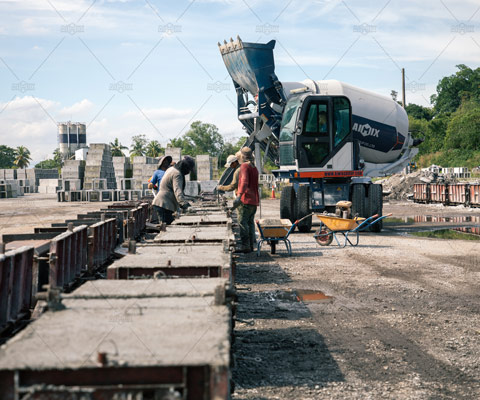
Product Consistency as a Market Positioning Asset for Malaysian Small Factories
Malaysian precast concrete product buyers — contractors, quantity surveyors, and procurement officers for infrastructure programs — are not uniform in their quality expectations. Tier-one buyers for major infrastructure contracts impose rigorous incoming inspection regimes, require product certification documentation, and specify factory audit compliance as a procurement prerequisite. These mini cement mixer buyers do not tolerate dimensional variability, surface defect frequency, or strength non-conformance — and they maintain supplier records that track performance across deliveries, removing consistently underperforming suppliers from approved lists without negotiation. For small Malaysian precast factories aspiring to supply this tier of the market, product consistency is not a quality aspiration. It is the entry requirement.
Dimensional Stability and Surface Quality as Mix Consistency Outcomes
Concrete mix consistency influences precast product quality beyond compressive strength. The workability of the fresh concrete — its flow characteristics, consolidation behavior, and bleeding tendency — determines how well it fills the mold geometry, how the surface finish quality of the cast face develops, and whether the dimensional tolerances specified for the product can be achieved consistently across production batches. A mix with inconsistent workability — varying from batch to batch because aggregate moisture corrections are imprecise or water addition is variable — produces casting behavior that requires constant adjustment of vibration parameters, pouring sequences, and demold timing, adding production complexity that reduces output efficiency and introduces product quality variability that systematic mix consistency would eliminate.
Self loading cement mixers with integrated moisture sensing on aggregate inputs — measuring the surface moisture of sand and aggregate before batching and adjusting the free water addition accordingly — deliver the mix workability consistency that stable casting operations require. This technology, available on advanced self loading mixer configurations, moves beyond simple weighing accuracy into active mix design management — automatically compensating for the aggregate moisture variation that Malaysian tropical climate storage conditions produce on a daily basis. For small precast factories whose production consistency has historically been constrained by aggregate moisture variability, this capability represents a step change in product quality stability that manual moisture estimation methods cannot approach.
Documentation and Traceability as Certification Support Tools
Malaysian precast product certification under SIRIM and project-specific quality management systems requires production records that demonstrate mix design compliance across certified production batches. Self loading concrete mixers with electronic batching systems generate this documentation automatically — recording batch weights, water additions, and production timestamps in a format that supports audit trail requirements without additional administrative labor. For small factories pursuing SIRIM product certification or seeking approved supplier status with major construction programs, this documentation capability removes a compliance barrier that manual batching systems create — the inability to demonstrate retrospectively that specified mix designs were followed consistently across certified production periods.
The commercial value of this documentation capability extends beyond certification compliance into supplier relationship management. Malaysian contractors managing major projects with structural precast requirements increasingly request batch production records as part of incoming material documentation — wanting evidence of mix design compliance rather than simply cube test results from finished products. Small factories that can provide this documentation differentiate themselves from competitors who cannot, supporting preferred supplier positioning that reduces pricing pressure and builds the long-term supply relationships that stable factory economics depend on. Precise weighing is therefore not merely a quality management tool — it is a commercial positioning investment whose return accumulates through the supplier relationships and market access it enables.
Practical Weighing System Requirements for Malaysian Small Factory Operations
Translating the case for precise weighing into operational practice requires understanding which weighing system specifications deliver genuine accuracy improvement in the Malaysian small precast factory context — and which represent costly overspecification that does not materially improve production outcomes relative to correctly specified simpler systems.
Load Cell Specification and Calibration Maintenance
Load cell-based weighing systems on self loading cement mixers achieve batching accuracy within plus or minus one to two percent of target weights for cement, aggregate, and water additions — a precision level that eliminates the significant variability of manual estimation methods while remaining practically achievable in field conditions. Maintaining this accuracy requires regular calibration checks — verifying load cell output against known reference weights at defined intervals and after any mechanical event that could affect the weighing system’s zero reference or sensitivity. Malaysian humidity and temperature conditions accelerate the electrical connection degradation that causes load cell drift if protection standards are inadequate, making enclosure quality and connector protection part of the weighing system specification for tropical climate deployment.
Operator Interface Design and Production Workflow Integration
Weighing system accuracy is only as valuable as the operator’s ability and willingness to use it correctly in production conditions. Self loading mixer weighing interfaces designed with production workflow in mind — clear weight displays readable in bright Malaysian sunlight, intuitive batch target setting, and audible or visual confirmation of target achievement before batch completion — support the operator compliance that translates weighing system capability into actual batching accuracy. Systems that are technically capable but operationally inconvenient generate workarounds that undermine their accuracy benefit in practice. The combination of technically sound weighing specification and ergonomically competent operator interface is what delivers the consistent mix quality that Malaysian small precast factories need to compete effectively in a market that rewards consistency with the long-term contracts that stable factory operations require.