
Heavy fishing trawlers are among the most demanding vessels to handle in shipyards, fishing ports, and marine maintenance facilities. Their large displacement, reinforced hull structures, wide beams, and heavy onboard equipment require specialized lifting and transportation solutions. In modern marine operations, the mobile boat hoist has become one of the most practical and efficient systems for handling these vessels safely and efficiently.
Also known as a marine travel lift or boat travel lift, a mobile boat hoist is designed to lift vessels from the water, transport them across shipyard areas, and position them for maintenance, storage, repair, or launching operations. These machines are widely used in fishing harbors, commercial shipyards, marina facilities, and coastal industrial projects because they provide flexible vessel handling without the infrastructure limitations of fixed dry docks or slipways.
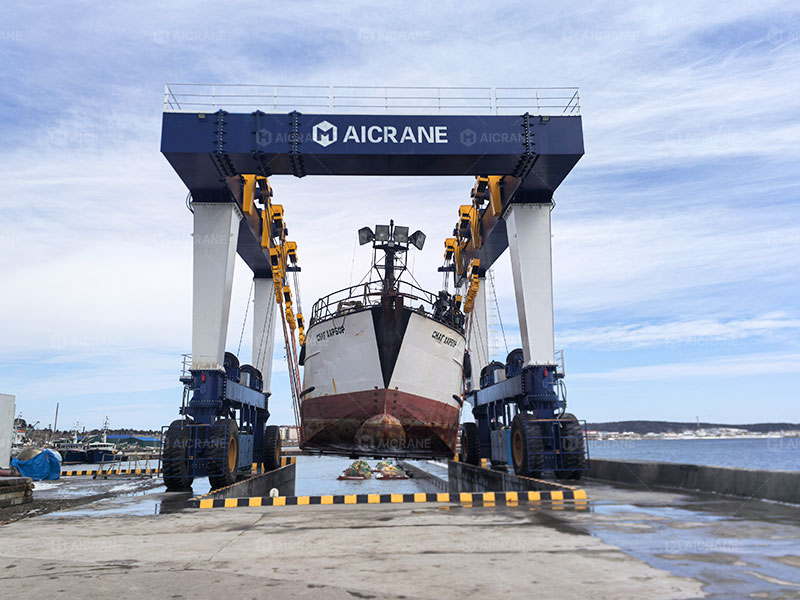
Why Heavy Fishing Trawlers Require Specialized Handling
Fishing trawlers differ significantly from leisure boats or standard yachts. Their operational design introduces several handling challenges:
- Higher hull weight due to reinforced structures
- Uneven weight distribution from engines, refrigeration systems, and fishing equipment
- Large beam widths for stability at sea
- Complex underwater appendages such as propellers, rudders, sonar domes, and stabilizers
- Continuous exposure to saltwater and harsh marine environments
Traditional lifting methods often struggle to accommodate these characteristics safely. Mobile boat hoists solve this problem through synchronized lifting systems, adjustable sling configurations, and high-capacity wheel-supported structures specifically engineered for heavy marine loads. Modern systems are available with lifting capacities ranging from 20 tons to over 1,500 tons for commercial vessel handling.
Lifting and Launching Heavy Fishing Trawlers
One of the primary applications of mobile boat hoists is lifting fishing trawlers out of the water for inspection, maintenance, and repair.
The process typically begins with the travel lift positioning itself over the vessel at the launch channel or dockside area. Adjustable lifting slings are carefully placed beneath structurally reinforced sections of the hull. Once secured, synchronized hoisting systems raise the vessel evenly to avoid hull distortion or imbalance.
Advanced mobile boat hoists use automatic load monitoring and synchronized lifting controls to maintain equal tension across all lifting points. This is especially important for steel or aluminum fishing trawlers that may carry asymmetrical internal machinery or storage systems.
After lifting, the trawler can be transported directly to maintenance bays, storage areas, or repair workshops without requiring additional handling equipment.
Compared with traditional dry docking methods, travel lifts offer several advantages:
- Faster vessel turnaround
- Lower infrastructure investment
- Flexible movement within the shipyard
- Reduced operational downtime
- Improved handling precision
For commercial fishing operations, minimizing downtime is critical because vessel availability directly affects revenue generation.
Dry Dock Maintenance Operations
Heavy fishing trawlers require regular maintenance to remain operational and compliant with marine regulations. Mobile boat hoists are widely used to support dry dock servicing operations such as:
- Hull cleaning
- Anti-corrosion coating application
- Propeller inspection
- Rudder maintenance
- Engine system servicing
- Structural welding repairs
- Sonar and navigation equipment inspection
Because fishing vessels operate continuously in harsh saltwater conditions, hull fouling and corrosion develop quickly. Efficient haul-out capability allows operators to perform maintenance on schedule while reducing long-term repair costs.
Mobile boat hoists also improve maintenance accessibility. Once transported to the repair zone, the vessel can be positioned precisely for technician access and equipment clearance.
Many modern shipyards rely on high-capacity travel lifts instead of permanent dry docks because the equipment offers greater operational flexibility and lower construction costs.
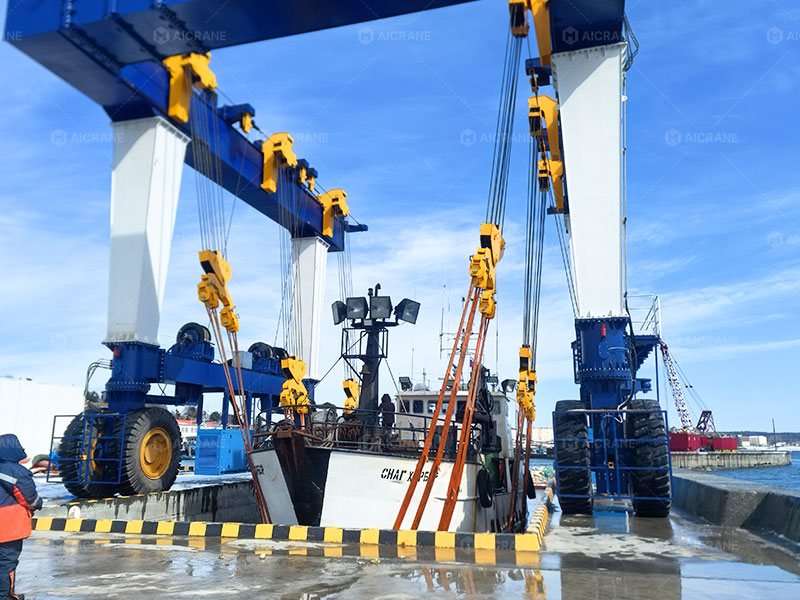
Handling Large Steel Fishing Vessels
Large commercial trawlers often feature steel hulls and extremely heavy onboard machinery. These vessels may include:
- Hydraulic net handling systems
- Ice storage facilities
- Refrigeration units
- Heavy-duty diesel engines
- Fuel tanks
- Fish processing equipment
The overall vessel weight can easily exceed several hundred tons.
Heavy-duty mobile boat hoists designed for commercial applications incorporate multiple sling sets, reinforced steel structures, and large tire configurations to distribute ground pressure effectively. Some advanced rubber tyred crane systems use 16-wheel or 32-wheel designs to improve stability while minimizing pavement stress.
This allows shipyards to handle large trawlers safely even in facilities where ground-bearing capacity is limited.
Fishing Port and Harbor Operations
In busy fishing ports, operational efficiency is essential. Mobile boat hoists help optimize vessel movement and reduce congestion within harbor facilities.
Common harbor applications include:
- Seasonal vessel storage
- Emergency haul-outs
- Rapid repair handling
- Dockside transfer operations
- Fleet maintenance scheduling
- Pre-inspection lifting
Unlike fixed lifting systems, mobile boat hoists can move freely throughout the facility. This flexibility allows operators to handle multiple vessels in different locations using a single lifting solution.
For fishing companies managing fleets of trawlers, this mobility significantly improves operational efficiency and space utilization.
Storm Protection and Emergency Recovery
Fishing vessels are highly vulnerable during storms, hurricanes, or extreme weather events. Mobile boat hoists play an important role in emergency vessel recovery and protection operations.
Before severe weather conditions arrive, trawlers can be lifted from the water and relocated to secure storage areas. This reduces the risk of:
- Dock collisions
- Mooring failures
- Hull impact damage
- Flooding
- Sinking
Additionally, if a fishing vessel becomes partially submerged or damaged at dockside, heavy-duty mobile boat hoists may assist in controlled recovery and transportation operations.
Their ability to maneuver large vessels in confined harbor spaces makes them especially valuable during emergency response situations.
Shipyard Vessel Transportation
Beyond lifting functions, mobile boat hoists are widely used for transporting fishing trawlers throughout shipyard facilities.
Modern shipyard crane systems support multiple steering modes, including:
- Straight travel
- Lateral movement
- Oblique movement
- Pivot steering
- Ackermann steering
These steering capabilities allow operators to maneuver large trawlers precisely through narrow service lanes and crowded work areas.
For facilities handling multiple fishing vessels simultaneously, efficient internal transportation greatly improves workflow organization and productivity.
Benefits of Mobile Boat Hoists for Heavy Fishing Trawler Handling
Improved Safety
Safety is one of the most important advantages of mobile boat hoists. Features such as synchronized lifting, real-time load monitoring, and adjustable sling positioning help prevent:
- Hull deformation
- Load imbalance
- Sling failure
- Structural stress concentration
- Vessel instability
Advanced control systems also provide precise operator control during lifting and transportation operations.
Reduced Infrastructure Costs
Traditional dry docks and rail systems require major civil engineering investments. Mobile boat hoists eliminate much of this infrastructure dependency.
Shipyards can expand operations more flexibly without constructing permanent lifting systems.
Operational Flexibility
A single mobile boat hoist can serve multiple operational zones within a fishing port or repair facility. This allows shipyards to optimize space utilization while supporting different vessel sizes and maintenance requirements.
Faster Vessel Turnaround
Fishing companies depend on quick maintenance cycles to maximize fleet productivity. Mobile boat hoists reduce lifting preparation time and improve workflow efficiency, allowing vessels to return to service faster.
Adaptability for Different Vessel Types
Modern mobile boat hoists can be customized for various vessel dimensions, hull forms, and lifting requirements. Adjustable width systems, multiple sling configurations, and customizable lifting points allow the same equipment to handle different fishing vessel classes efficiently.
Future Trends in Heavy Fishing Vessel Handling
As commercial fishing vessels continue to increase in size and complexity, mobile boat hoist technology is also evolving.
Emerging industry trends include:
- Electric and hybrid-powered travel lifts
- Automated load balancing systems
- Remote control operation
- Smart diagnostics and predictive maintenance
- Real-time pressure monitoring
- Low-emission vessel handling systems
Some manufacturers are already introducing fully electric mobile boat hoists designed to reduce emissions and improve environmental sustainability in shipyard operations.
These innovations will further improve safety, efficiency, and environmental performance in heavy fishing trawler handling applications.
Conclusion
Mobile boat hoists have become essential equipment for handling heavy fishing trawlers in modern marine industries. Their ability to safely lift, transport, launch, and position large commercial fishing vessels makes them highly valuable for shipyards, fishing ports, repair facilities, and commercial fleet operators.
Compared with traditional vessel handling methods, mobile boat hoists provide superior flexibility, faster operational turnaround, lower infrastructure costs, and improved safety performance. With lifting capacities exceeding 1,000 tons and advanced control technologies now available, these systems are fully capable of supporting the demanding requirements of large-scale fishing vessel operations.
As the global fishing industry continues to modernize, mobile boat hoists will remain a critical solution for efficient and reliable heavy trawler handling in marine environments.